Eyasu Yikunoamlak
A young man from Addis Ababa who was traveling to find better opportunities. Also spelled Eyassu.
11 Years of Remembrance · Ethiopian Martyrs
This memorial honors Ethiopians murdered in Libya, keeping their names and stories present with reverence and care.
The Story
Reported by Aryn Baker with reporting by Binyam Tamene / Addis Ababa
One day in late April a new video surfaced on the social media site of the Libyan branch of the Islamic State of Iraq and Greater Syria (ISIS). In it, a dozen men clad in orange jumpsuits kneel on a white sand beach before their knife-wielding executioners. In the next scene, filmed in the desert this time, another 16 prisoners are dressed in black. Behind the kneeling men in black stand 16 masked soldiers of the Islamic State, each holding a pistol to his prisoners' head. In what has become a familiar trope in ISIS videos, one of the masked men points his pistol to the camera and declares, in a strong American accent, that he is doing the will of Allah.
As the soundtrack crescendos, the 29-minute-long video jumps between scenes of firing-squad carnage and gruesome images of individual beheadings. In the beach scene close-ups, militants drain the blood of their victims into the Mediterranean, staining the sea red.
The action movie-style editing and shock-value symbolism are typical of what the world has come to expect from the lurid propaganda videos made by ISIS. But these victims were not soldiers captured in combat, like the Jordanian pilot burned alive on camera a year ago. They were not even citizens of a country militarily aligned against the Islamic State, like the American journalist James Foley, beheaded by ISIS in August 2014. They were African migrants making their way to a better life in Europe, captured along the route to the smuggler's boats that depart daily from the Libyan coast for Italy's shores.
"My brother died on the sands of Libya like an animal, for a dream that he was going to change his life."
It is on those bloodstained sands that the multiple strands of Europe's migrant crisis — the rise of ISIS, Libya's lawlessness, unscrupulous human traffickers and the lure of opportunity and security in European capitals — convene to tell a second chapter. At least seven of the 28 men in the video come from the brutal dictatorship of Eritrea, and — like the Syrians, Afghans and Iraqis crossing into Europe — would have likely been eligible for asylum had they reached their destination.
But most of the men came from Ethiopia, a once-desperately poor East African nation now on track to reach middle-income status in the next ten years, according to the World Bank. Many of the men were educated. Some had jobs, and others ran their own businesses. They, or their families, had enough means to scrape together $3,000–$4,000 in smuggler's fees — a fortune in a country whose annual per-capita income is still only $550.
The International Organization for Migration (IOM) estimates that some 80,000 Africans crossed the Mediterranean in 2015, part of the biggest wave of migrants since World War II. War and terrorism still drive people from their homes: at least seven African nations, from Nigeria under siege by Boko Haram to South Sudan and its civil war, have active conflict zones.
According to the head of the Association of Ethiopian Overseas Recruitment Agencies, an estimated 200,000 Ethiopians a year use illegal means to seek jobs abroad, mostly to the Middle East, South Africa and Europe. One of them was 38-year-old Balcha Belete, a strikingly handsome electrical engineer who lived in Addis Ababa, Ethiopia's capital, and had a low-paying job with a government-owned power company. The unmarried youngest child of 14 siblings, he was known as the brother you could turn to in an emergency, and the uncle who would do anything for his nieces and nephews.
Yet without saying a word to his close-knit family, Belete left home earlier that year, crossing from Ethiopia into Sudan on Valentine's Day accompanied by his neighbor, Eyassu Yukuno-Amlak. It was the first step of a journey that would end abruptly in southeastern Libya a little more than two months later, where the two men and fourteen others were filmed being shot, execution style, by soldiers of ISIS. "My brother died on the sands of Libya like an animal, for a dream that he was going to change his life," says Belete's sister Belynesh. She, like the rest of her family, only realized that her brother had died when they watched the video of his execution broadcast on a satellite news channel. "He thought he was going to England," she surmised, breaking into tears over his memory. "But he didn't even make it to the Mediterranean."
Rising from the ashes of a devastating famine that killed an estimated 400,000 in the early 1980s, Ethiopia has made extraordinary gains in health care, poverty reduction and education. With an average growth of 10.7 percent over the past decade — better than China or India — Ethiopia now has the fastest growing economy in Africa.
Balcha Belete was dissatisfied in his job, say his siblings, and felt that he should have been doing better, considering his skills and education. He also thought that once he made it in Europe, he would be able to bring over his nieces and nephews, to give them the opportunities he found lacking at home. "He always said that he wanted to take all four of us to Germany where we could get a good education," says his 15-year-old niece Sara Lema.
"The people who we are losing, they are economically active, they are dynamic, they are people who refuse to live in poverty. These are the people Africa needs: the ambitious, driven risk-takers."
Libya is Africa's doorstep to Europe, and the collapse of its government following the 2011 uprising opened up new opportunities for smuggling networks. Balcha Belete's family didn't know until after his death that he had paid a smuggler 90,000 birr ($4,286) for the crossing. At each stop in the journey, the two men phoned for funds to be wired. Soon after they crossed into Libya, in March, the calls stopped.
Of the 3,771 migrants who went missing or died on their way to Europe via the Mediterranean in 2015, nearly 3,000 died on the central route from Libya and Tunisia, according to IOM. Yet despite efforts to publicize these risks, migrants are still willing to gamble.
The Ethiopians killed by ISIS were not illiterate, impoverished people fleeing hunger, but rather skilled high school and university graduates. "The people who we are losing, they are economically active, they are dynamic, they are people who refuse to live in poverty," says Mohamed Yahya of the UNDP. "These are the people Africa needs: the ambitious, driven risk-takers." It is ironic that the $4,000 it costs to pay passage to Europe would be enough to start a small business in Ethiopia.
"Balcha was just trying to make life better for his family. That dream died in Libya."
Originally reported by Aryn Baker with reporting by Binyam Tamene / Addis Ababa. Published in TIME Magazine. Reproduced here for memorial and educational purposes.
Why This Memorial
Safeguard the identities and stories of those lost, with care and clarity.
Offer a trusted resource that helps communities remember and teach.
Recognize steadfast belief and the dignity of every life taken.
To mobilize faith, resources and community to build sustainable institutions that serve, heal and uplift.
Featured Martyrs
Featured names are placeholders until verified records are shared. Each story deserves dignity and accuracy.
A young man from Addis Ababa who was traveling to find better opportunities. Also spelled Eyassu.
A neighbor and close friend of Eyasu. His family recognized him in the video; he was known in his community as a kind and hardworking person.
Remembered with reverence as one of the Ethiopian martyrs taken in Libya in April 2015.
Dozens
Martyrs Remembered
April 2015
Month of Loss
Ongoing
Legacy
Historical Context
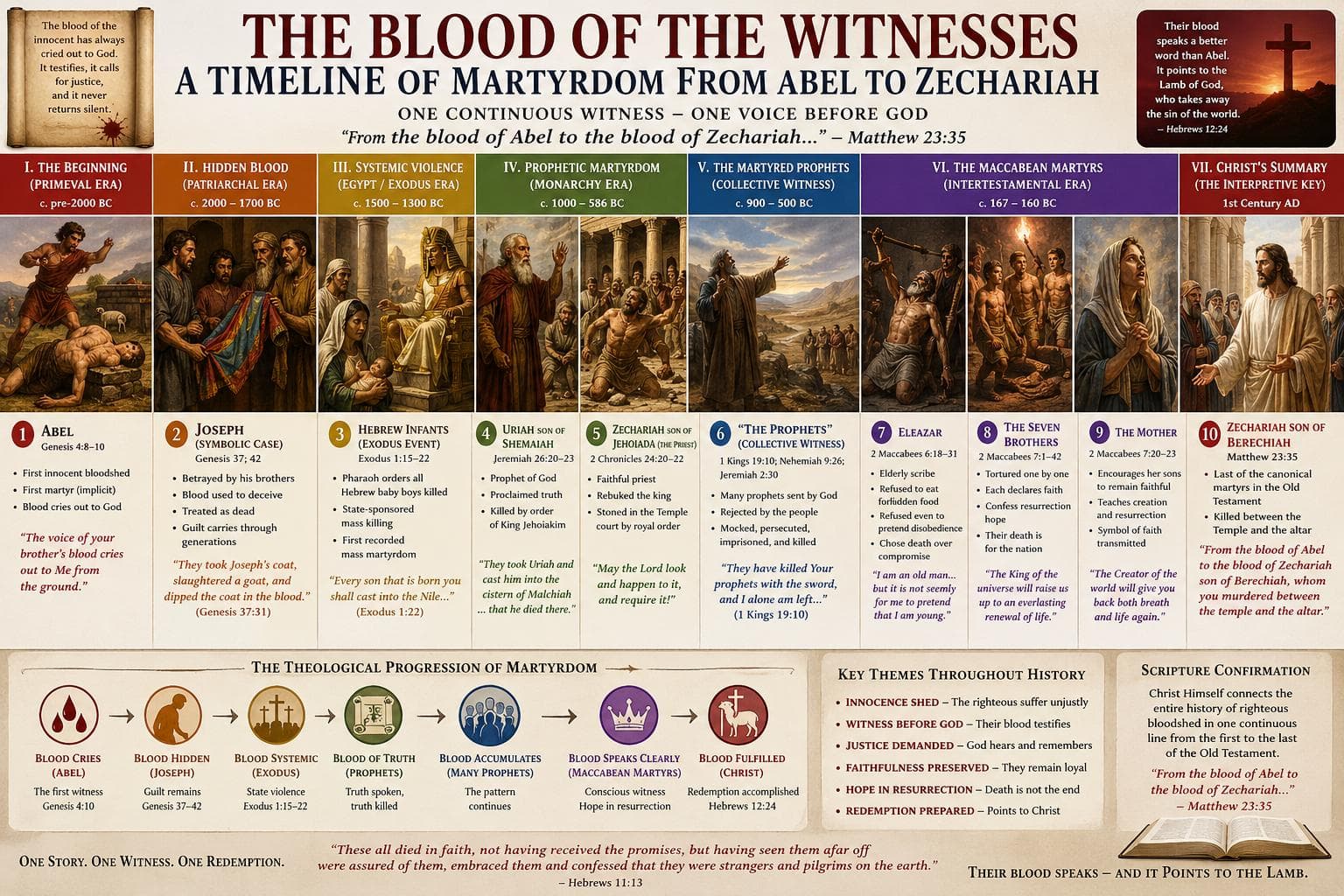
The sacrifice of Ethiopian Christians spans centuries — from the earliest days of the Aksumite Empire to the twenty-first century. Understanding this heritage deepens the weight of what was lost in April 2015.
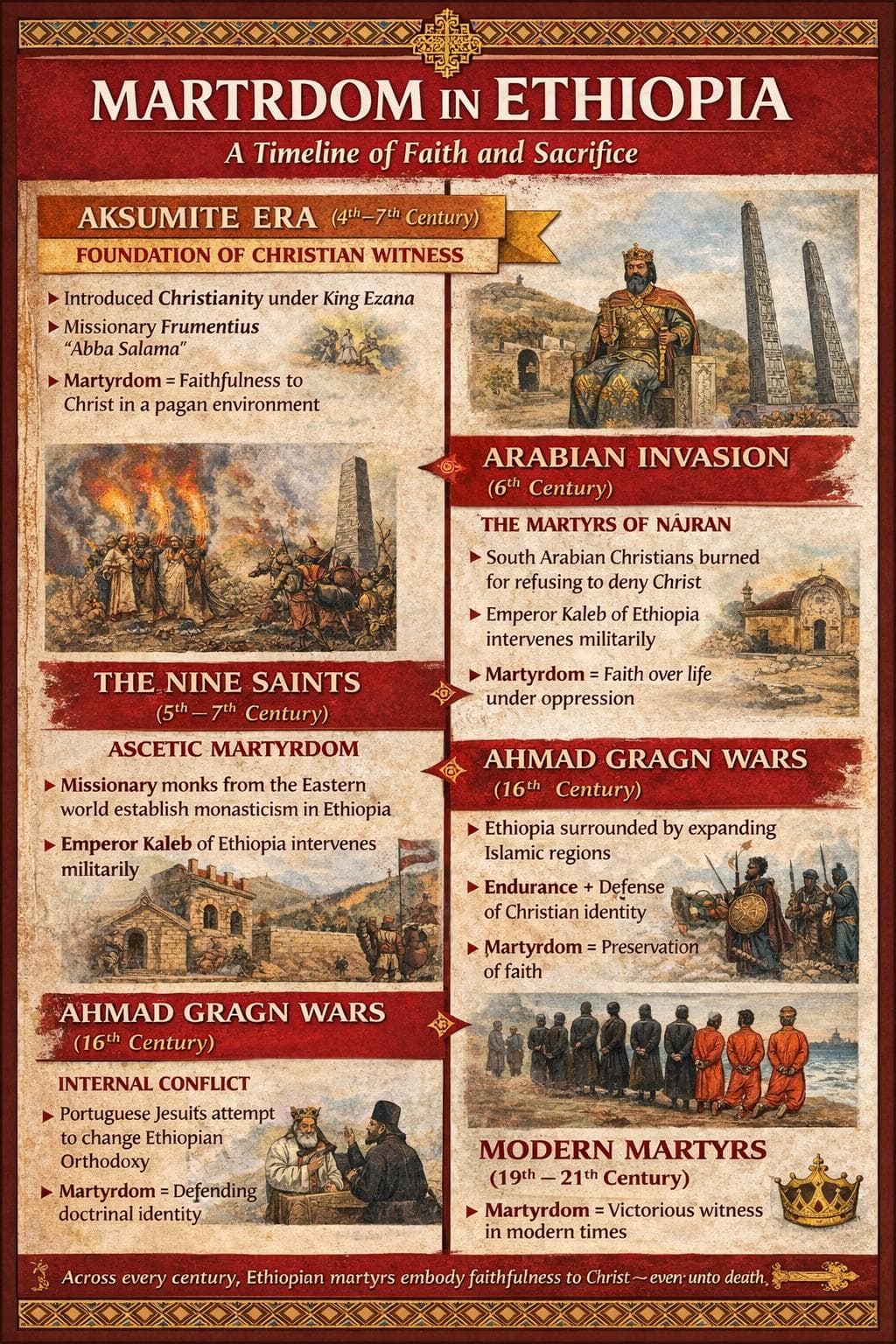
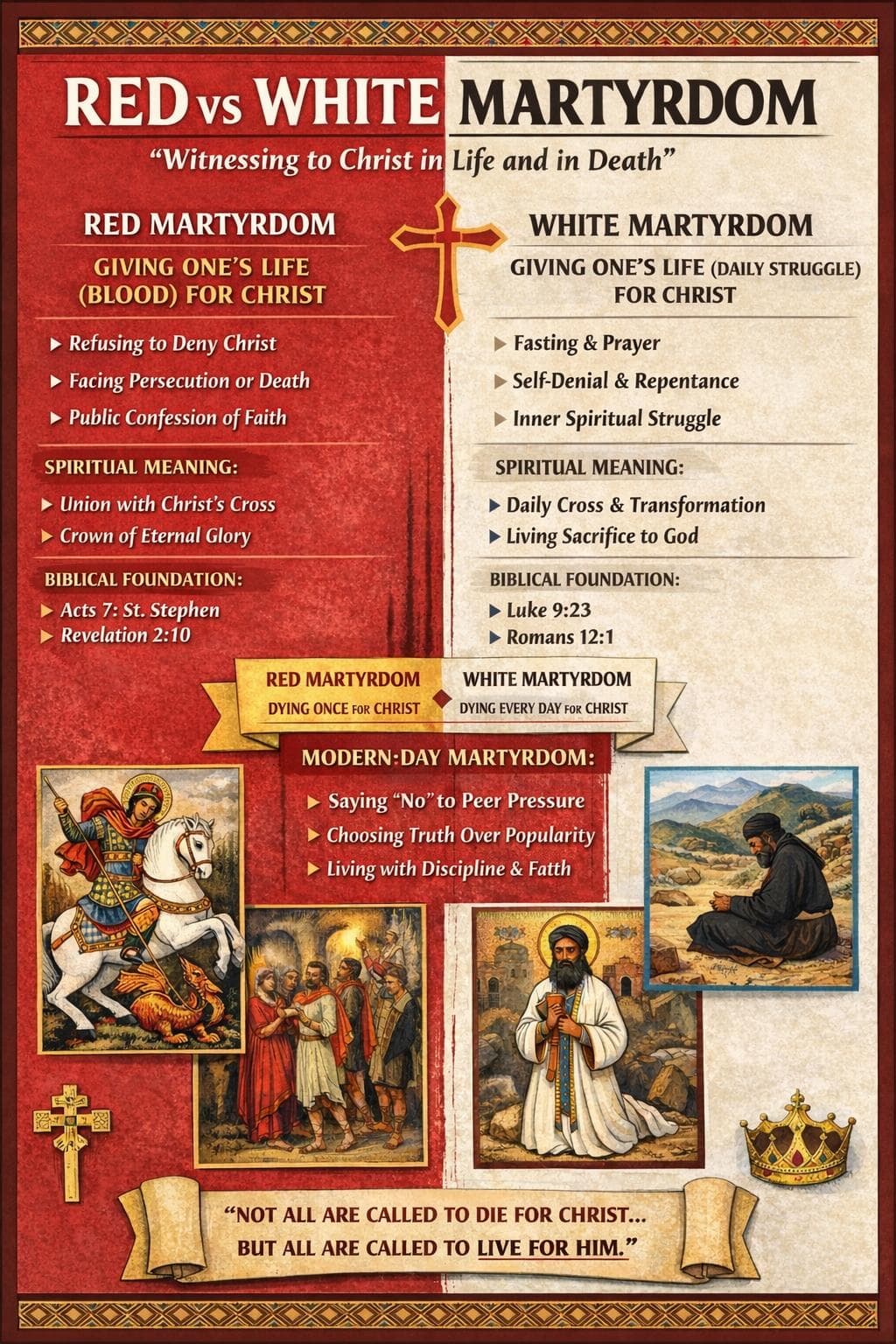
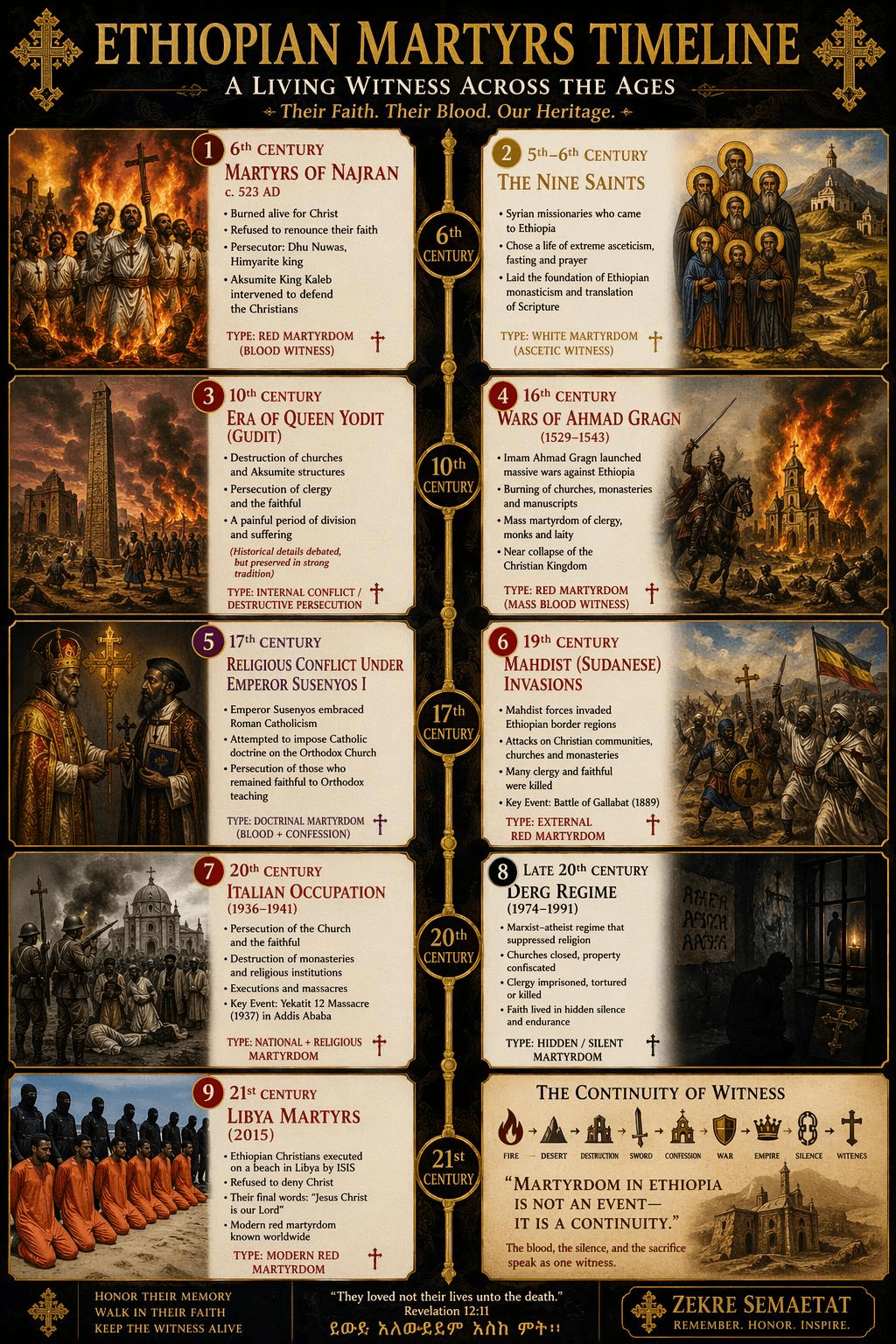
Witnesses Through the Ages
Click any card to read their story.
"Not all are called to die for Christ… but all are called to live for Him."
Video Sources
A collection of video testimonies and documentary records related to the Ethiopian martyrs of April 2015.
Zekre Sematat is a quiet, respectful space for remembering Ethiopians who lost their lives to ISIS. It preserves their names with dignity and invites reflection rather than spectacle.
This memorial is non-graphic, non-political, and centered on honoring the deceased and supporting the communities that mourn them.
Our goal is to keep these stories available for future generations and to encourage a culture of remembrance grounded in compassion.
Families, churches, and community historians can submit verified information to help preserve each story with dignity and care.
Contact
contact@zekresematat.org
Please include sources or references so each account can be honored accurately.
Or visit the full contribute page →